Jacob Bowie
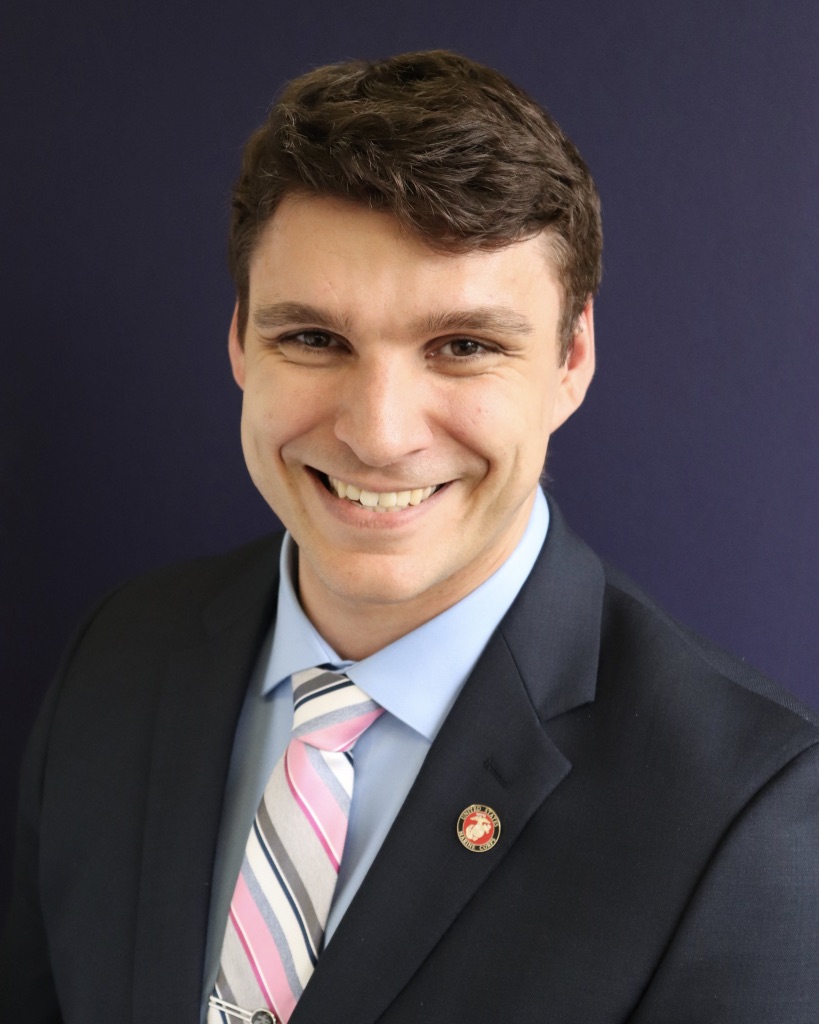
Jacob Bowie, PhD
Postdoctoral researcher, UConn Human Performance Laboratory & Korey Stringer Institute. Applying machine learning, wearable sensor signal processing, and reproducible analysis pipelines to questions in exercise and environmental physiology.
Currently seeking longer-term postdoctoral and industry roles at the intersection of applied ML, wearables, and human physiology. jacob.bowie2@gmail.com
About
I study how the human body adapts to exercise and heat. My work focuses on how to measure those adaptations rigorously, how individual responses vary, and how to translate physiological signals from wearables and laboratory instruments into decisions about training, recovery, and risk.
My methodological work combines mixed-effects models, unsupervised clustering, and time-series feature extraction across heart rate, heart rate variability, core temperature, accelerometry, and multi-omics data (transcriptomics, proteomics, metabolomics). I work primarily in R and Python, with a strong preference for reproducible, version-controlled, container-portable analysis.
- R (tidyverse, lme4, brms)
- Python (pandas, scikit-learn)
- Mixed-effects models
- Unsupervised clustering
- Time-series signal processing
- Wearable sensor data
- Multi-omics analysis
- Bayesian methods
- Quarto / R Markdown
- Git & reproducible pipelines
- Docker
- Clinical study design & IRB
Selected work
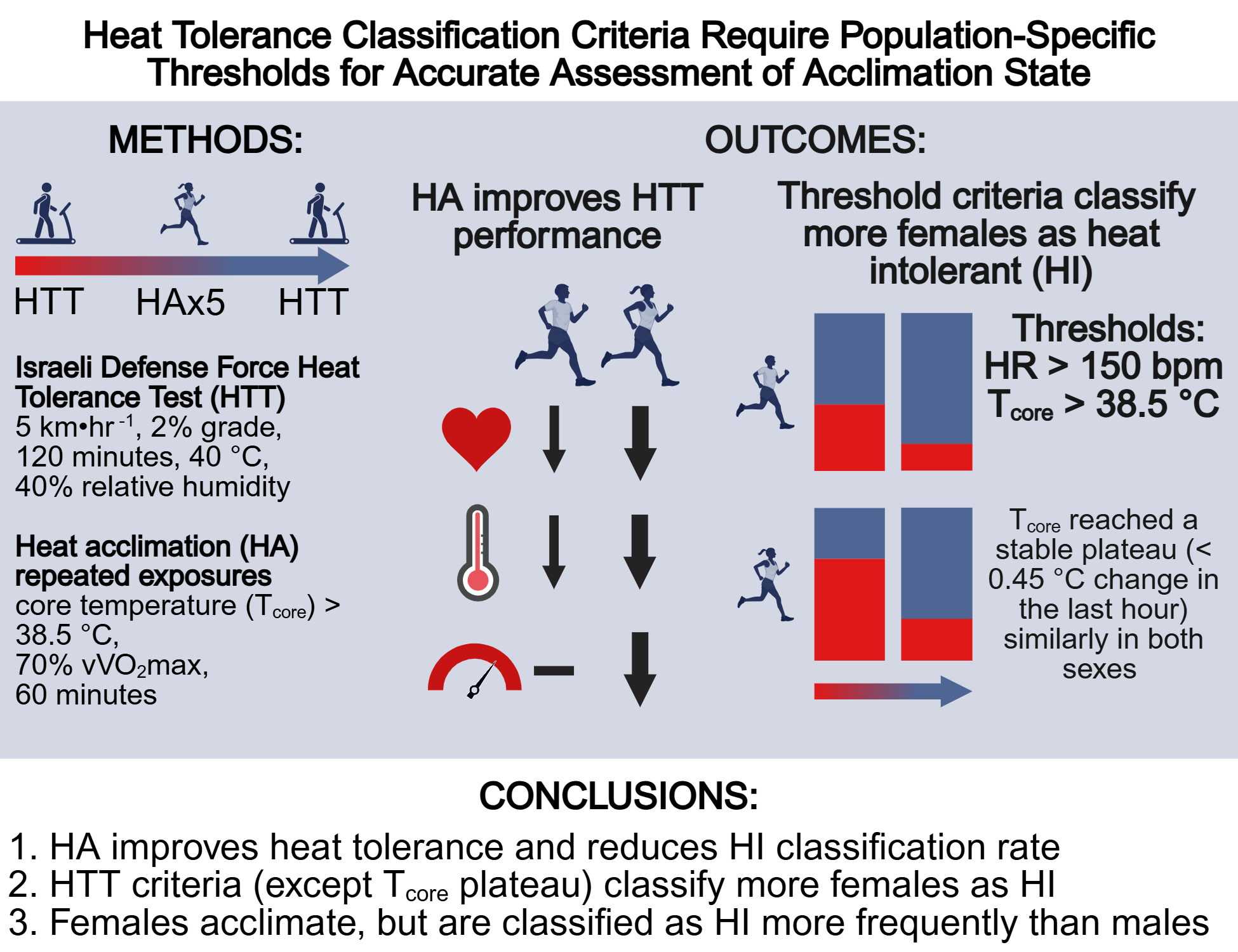
Heat tolerance classification criteria require population-specific thresholds
Re-examined the standard heat tolerance test classification criteria in a young adult cohort and showed that a single fixed threshold misclassifies acclimation state. Population-specific thresholds, built from clustering of thermoregulatory response curves, yield substantially better agreement with downstream physiological markers of acclimation.
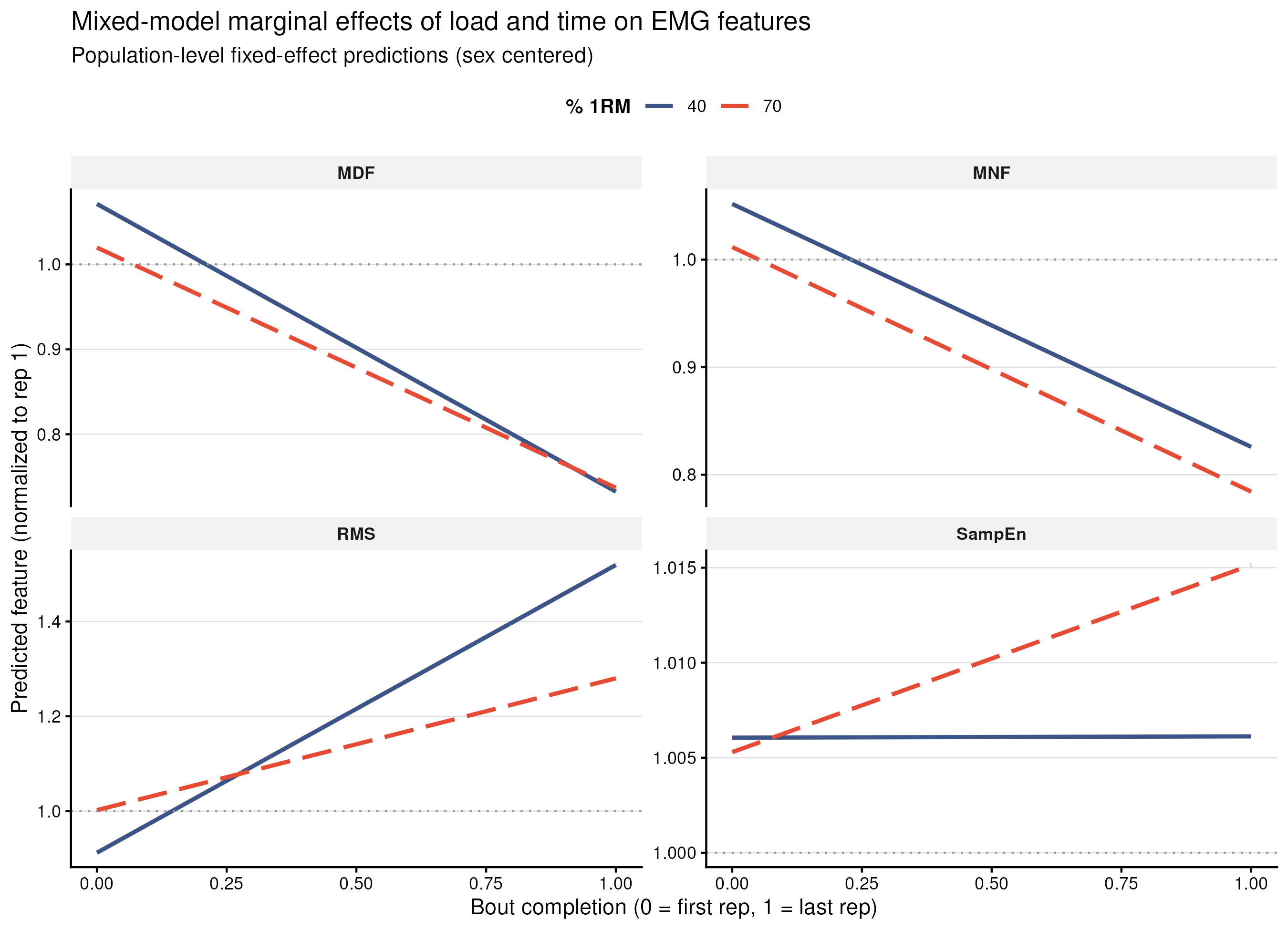
Surface EMG amplitude rises faster at low than high load during knee extension to failure
Within-bout root-mean-square EMG amplitude rose more steeply during unilateral leg extension to failure at 40% than at 70% of one-repetition maximum (Holm-adjusted p < 0.001 for the load × time interaction). Spectral indices and sample entropy did not separate the two loads. The pipeline is built end-to-end in R + Quarto inside a pinned Docker image for reproducibility. Manuscript in preparation for the International Journal of Exercise Science.
Repository will be released alongside the manuscript.
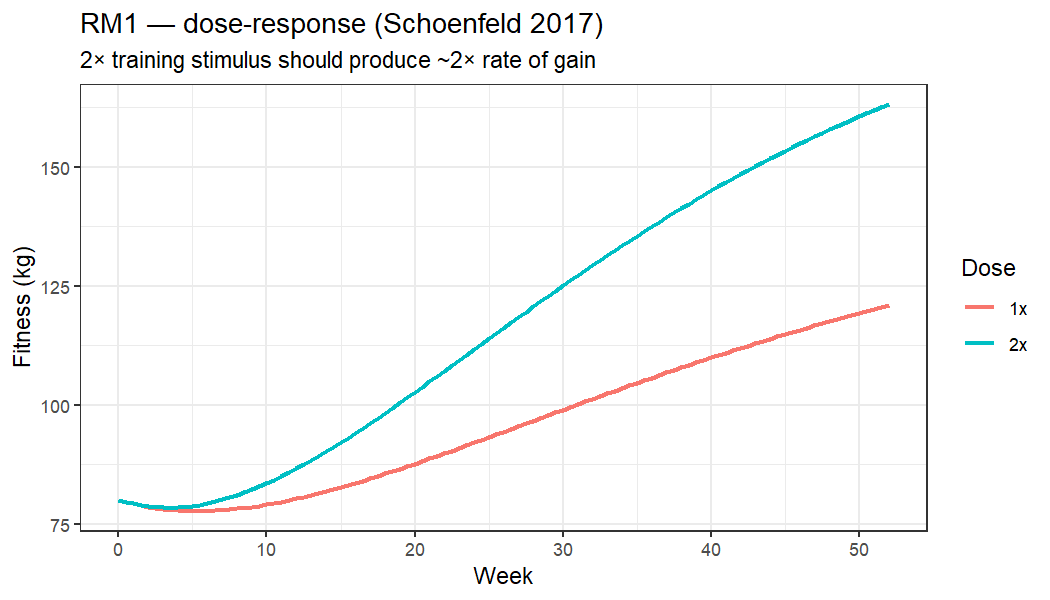
rtSD Explorer: an interactive fitness-fatigue model explorer
A deterministic forward-simulator for the MEDv4 fitness-fatigue-signal ODE, the three-stock system-dynamics model that sits behind a long lineage of resistance-training adaptation research from Banister 1975 through to modern Bayesian extensions. Ships with a seven-test physiological-plausibility validator anchored to canonical RT literature. The explorer runs entirely in your browser via marimo + Pyodide, with an R Shiny app and reproducible Docker image in the same repo.
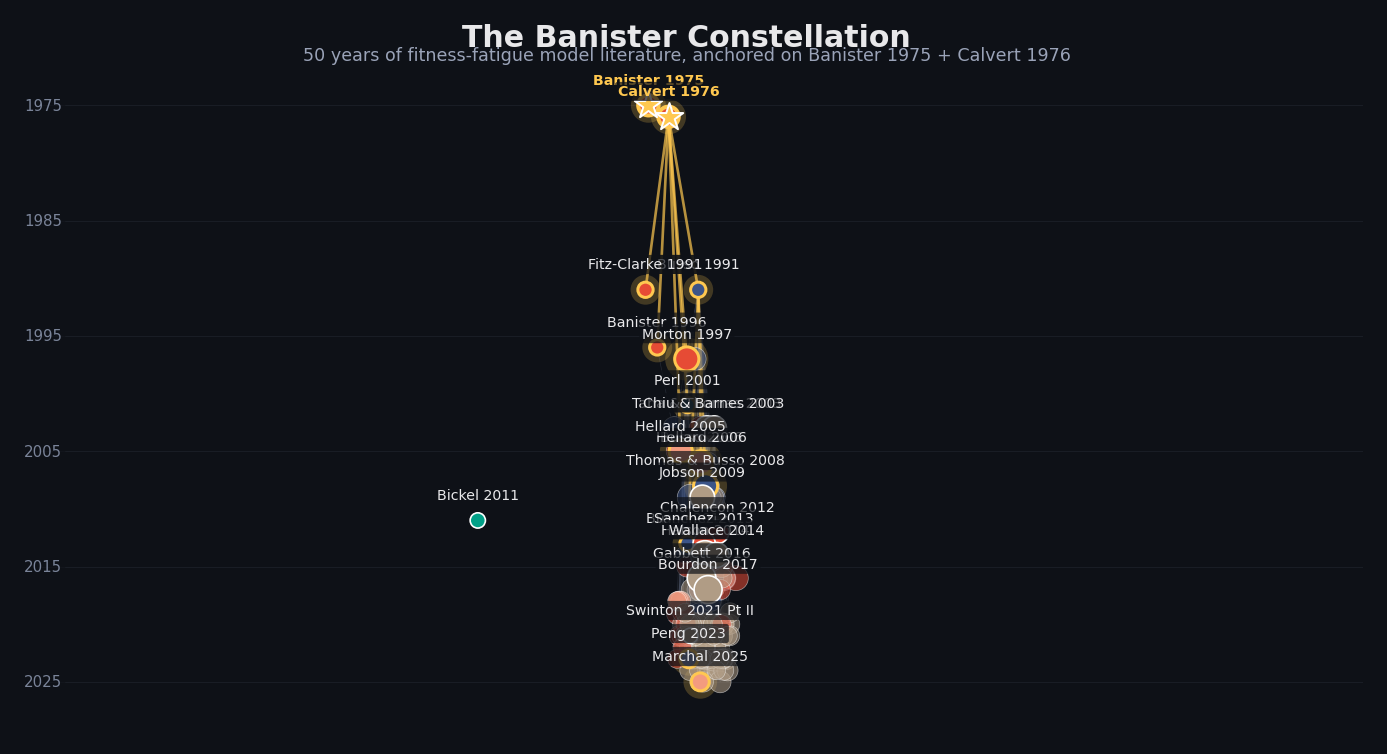
The Banister Constellation: a citation graph of the fitness-fatigue model lineage
Fifty years of fitness-fatigue model literature in one constellation. A 175-paper, 524-edge citation graph anchored on Banister 1975 and Calvert 1976, traced through the classical extensions of the 1980s and 1990s, the variable-dose and statistical critiques of the 2000s, and the modern Bayesian hierarchical reformulations. Built on a private DuckDB literature index; interactive viewer and source release planned.
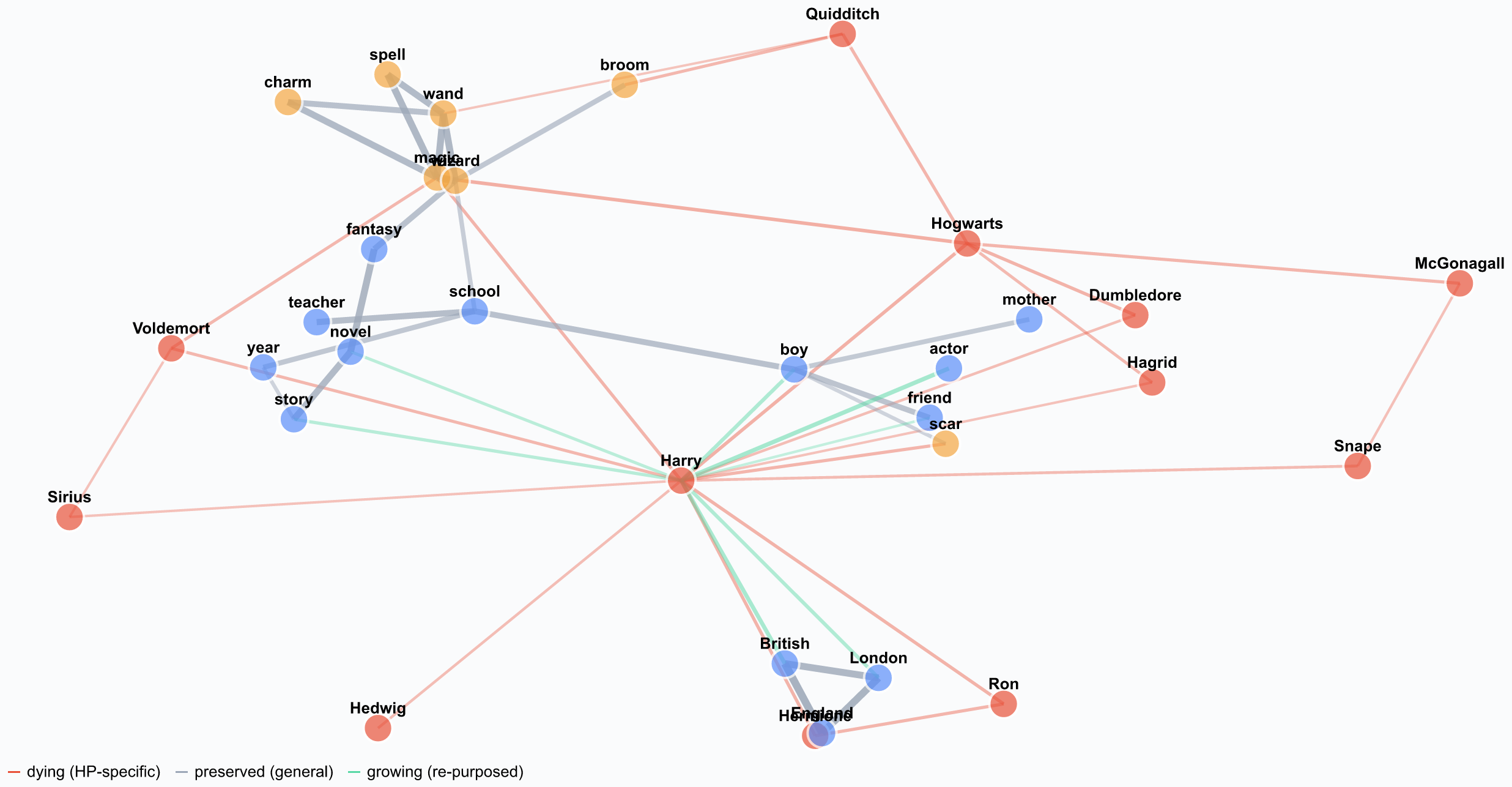
Who’s Harry Potter? An interactive walk through approximate unlearning in LLMs
Llama-2-7B took 184,000 GPU-hours to train. In 2023, Eldan and Russinovich at Microsoft Research showed that one GPU-hour of fine-tuning can make it forget Harry Potter, with no retraining from scratch and no measurable loss of general competence. This interactive notebook walks through the mechanism: not deleting the word “Harry” but cutting the edges between “Harry” and “Hogwarts”, “magic”, “Quidditch”. Drag a slider and watch the Harry Potter cluster pull itself apart while the surrounding language graph stays intact. Runs entirely in your browser via marimo + Pyodide.
Literature acquisition and citation-graph toolkit
An open-source biomedical paper acquisition and citation-graph snowballing toolkit I built and use across a portfolio of research projects. Cascades Unpaywall to PubMed Central to preprint mirrors, indexes everything in DuckDB, walks forward and reverse citation graphs, and includes a small MathML-to-LaTeX rendering layer for JATS XML sidecars (76% pass rate through pdflatex on retrieved full-text articles).
Selected publications
- Bowie JS, Szymanski MR, Struder JF, Filep EM, Morrissey-Basler MC, Brewer GJ, Thornton SN, Mahoney KJ, Sekiguchi Y, Kwon OS, Chon K, Casa DJ, Lee EC. Heat tolerance classification criteria require population-specific thresholds for accurate assessment of acclimation state in adults. Physiological Reports, 2026. doi:10.14814/phy2.70745
- Mahoney KJ, Bowie JS, Ford AE, Perera N, Sekiguchi Y, Fothergill DM, Lee EC. Plasma proteomics-based discovery of mechanistic biomarkers of hyperbaric stress and pulmonary oxygen toxicity. Metabolites, 2023; 13(9): 970. doi:10.3390/metabo13090970
- Lee EC, Bowie JS, Fiol A, Huggins RA. Molecular aspects of thermal tolerance and exertional heat illness susceptibility. In: Adams WM, Jardine JF, eds. Exertional Heat Illness: A Clinical and Evidence-Based Guide. Springer International Publishing, 2020: 149–168. doi:10.1007/978-3-030-27805-2_8
Full publication list, including works in preparation and conference abstracts, is in my CV and on ORCID.
Contact
The best way to reach me is by email: jacob.bowie2@gmail.com.
I read messages most days and reply within a few business days. For collaboration inquiries please include a one-paragraph summary of the question and any data or design constraints I should know about up front.