The Banister Constellation
A citation network of the fitness-fatigue model lineage
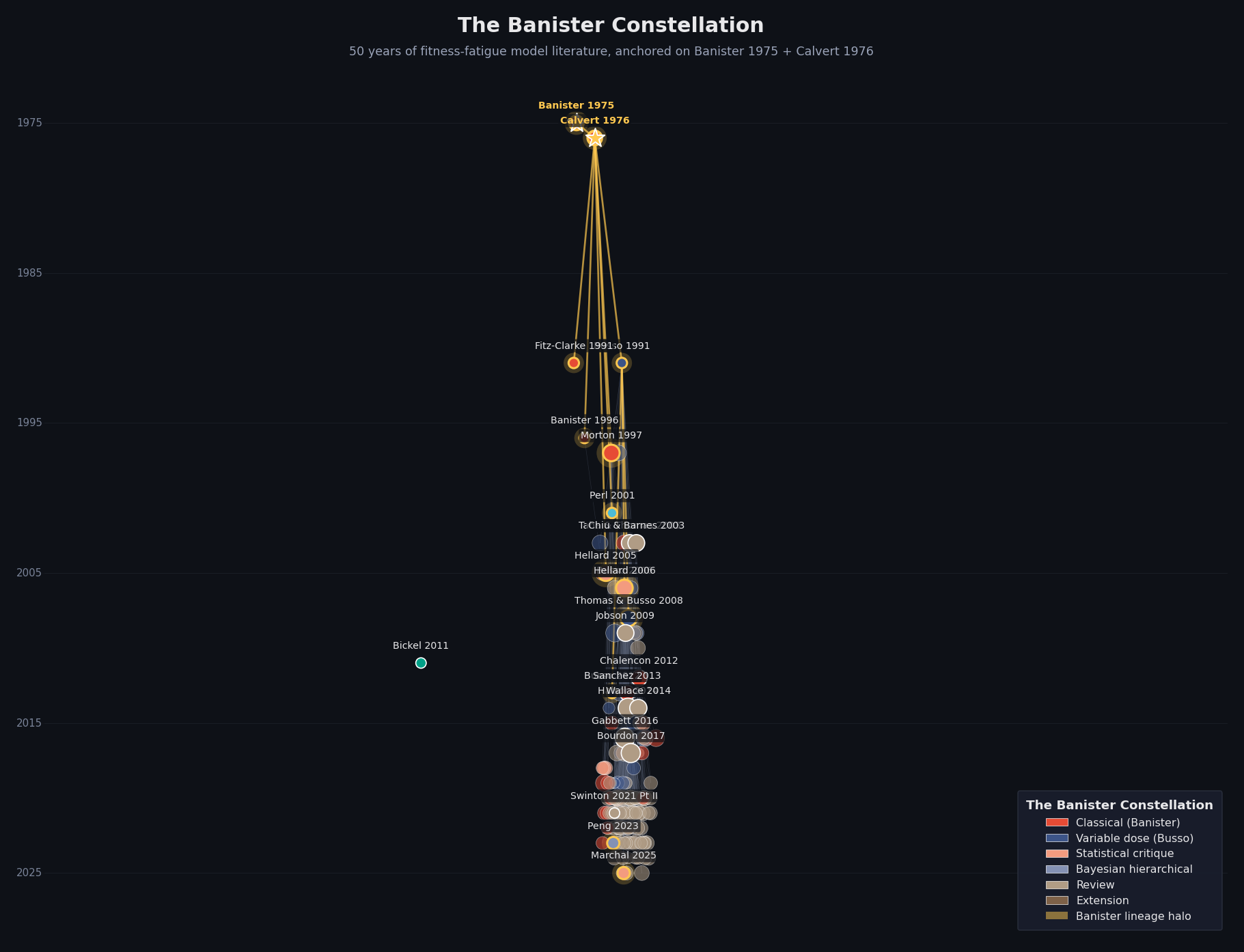
Fifty years of fitness-fatigue model (FFM) literature in one constellation. Anchored on Banister 1975 + Calvert 1976; 175 papers across classical, variable-dose, statistical-critique, and Bayesian-hierarchical branches, with a 14-paper Banister lineage chain reconstructed from parent_doi annotations.
What this is
In 1975, Eric Banister sketched a two-stock model — Fitness and Fatigue — that turned every training session into a pulse of stimulus, every adaptation into an exponential decay, and every performance prediction into the difference of two convolutions. The math fit on a napkin. Fifty years later, that napkin underwrites everything from elite-endurance taper planning to the Bayesian hierarchical models I use in my dissertation.
This visualization is the family tree.
Every node is a paper. Every edge is a citation, drawn from the local getpaid literature pipeline (Semantic Scholar forward citations + CrossRef references). The gold halos mark the 14-paper Banister lineage — the direct chain of authorship from the 1975 systems-model paper through the 2025 Bayesian-hierarchical critiques. Colors code the methodological family: classical Banister-Calvert, Busso’s variable-dose extensions, the statistical-critique line, the PerPot metamodel, and the recent Bayesian-hierarchical wave.
What the constellation reveals — and what I find most useful about it — is the sparsity of internal citation. The FFM literature is not a tightly woven graph. It’s a small number of foundational papers, a long tail of isolated re-derivations, and a recent dense cluster of statistical re-evaluations (Marchal 2025, Hellard 2006, Imbach 2022) that converge on the same conclusion: the single-subject FFM is ill-conditioned, and the path forward is hierarchical partial pooling.
Try it
The interactive renders in your browser via vis-network. Drag to pan, scroll to zoom, hover any node for the paper title, authors, venue, and citation count. Toggle the Lineage only button to isolate the 14-paper Banister chain.
For visitors who want to fork the source-editing experience, the marimo notebook is also available at /citation-network/notebook/ — though Pyodide cold-start is ~30-60 s on first visit.
How it was built
canonical_ffm_seeds.csv  ── 25 curated FFM founding papers
       │
       └─ extract.py ─── DuckDB (portfolio.duckdb)
                ├── forward citations (Semantic Scholar)
                ├── backward references (CrossRef)
                └── extension-family inference (which seeds did this paper link to?)
                          │
                          └─ public/data/{nodes,edges}.csv
                                    │
                                    ├─ notebook.py (marimo + vis-network)  →  WASM bundle
                                    ├─ build_html.py                       →  standalone HTML
                                    └─ render_static.py (matplotlib)       →  hero + social cards
The trunk is curated — 25 founding-equation papers anchored on Banister 1975 and Calvert 1976, tagged with family (classical / variable-dose / statistical-critique / Bayesian-hierarchical / PerPot / review) and linked to their direct intellectual parent. The extension layer is automatically expanded: for each trunk paper, pull the top-150 most-linked neighbors from my local citation index, infer each extension’s “best-matching family” from the trunk papers it cites most, and render the result.
Source: JacobBowie/citation-network · MIT (code) + CC-BY-4.0 (data)