rtSD Explorer
An interactive system-dynamics explorer for resistance-training adaptation
A browser-based explorer for the MEDv4 fitness-fatigue-signal model, the three-stock system-dynamics ODE behind fifty years of resistance-training adaptation research. Pick a training program, drag the parameters, and watch Fitness, Fatigue, Signal, and net Performance evolve. Runs entirely in your browser via marimo + Pyodide; backed by a parity-tested R + Python core and a seven-test physiological-plausibility gate.
Try it
rtSD Explorer is an interactive model of how resistance training builds and erodes fitness. Pick a training program, drag the parameters, and watch four quantities (Fitness, Fatigue, Signal, and net Performance) evolve week by week. Save a run and overlay later ones to compare regimes side by side.
Open the interactive explorer →
Runs entirely in your browser via marimo + Pyodide. No install, no server, no Python on your machine.
Inside, you can:
- Choose among five training programs (standard weekly, high-frequency, detraining, untrained baseline, and Renaissance-Periodization mesocycles).
- Tune the model parameters (training volume, adaptation rate and delay, atrophy, recovery time constants, baseline) and watch every panel recompute live.
- Save a run to freeze a configuration, then change the parameters and overlay the new trajectory against it.
- Read the result three ways: live trajectory charts (Fitness, Fatigue, Signal, Performance), the MEDv4 stock-and-flow diagram, and a summary table.
First load takes roughly 30 to 60 seconds while Python downloads into the browser. After that it is local and fast.
What you’re looking at
In 1975, Eric Banister modeled training as two stocks, Fitness and Fatigue: every session is a pulse of stimulus, every adaptation an exponential decay, and predicted performance the difference between the two. That lineage, through Calvert, Busso, Morton, and the modern Bayesian reformulations, has scaffolded half a century of training-adaptation research, yet most of it lives in figures rather than in code you can run.
rtSD Explorer makes the dynamics tangible. How does a doubled training dose change the long-run fitness trajectory? Where do extra sessions stop paying off? How fast does detraining erase a year of work? The explorer answers questions like these by simulation, in the browser, with no model-fitting required.
Underneath, rtSD is a system-dynamics implementation of the MEDv4 three-stock fitness-fatigue-signal ODE, originally built in Vensim and ported to a parity-tested R + Python core. It sits inside a three-tier framework:
| Tier | Name | What it is |
|---|---|---|
| Framework | GET-PAID | Generating Expected Timelines of Predicted Adaptations to Imposed Demands. The theoretical claim that imposed training demands produce predictable adaptation trajectories. |
| Model | rtSD | The system-dynamics implementation of GET-PAID for resistance training: a three-stock (Fitness / Fatigue / Signal) model on the MEDv4 ODE. |
| Tool | rtSD Explorer | This page. The browser-based marimo explorer above, backed by the same model that powers the repo’s R Shiny app and Docker image. |
The seven-test plausibility validator
The methodological heart of the project is not the simulator. It is the validator that gates it.
A fitness-fatigue model has to satisfy a set of qualitative physiological constraints before it deserves to be fit to data. These are not noise-bound empirical claims; they are structural commitments. The seven reference-mode tests encode them, and the model has to reproduce each one within tolerance before any change ships:
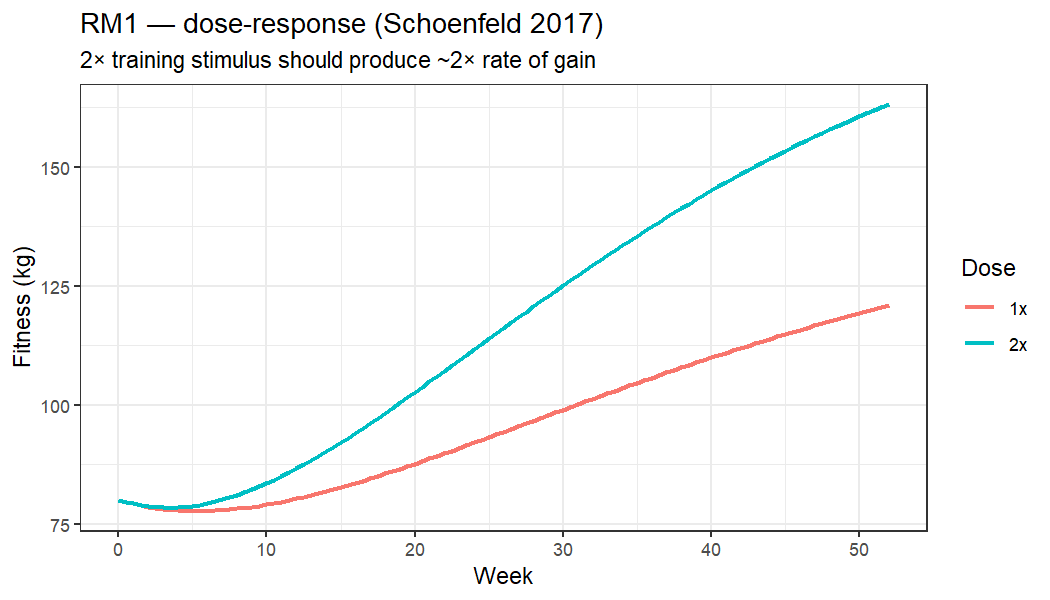
- RM1: dose response. Doubling training dose roughly doubles the long-run rate of fitness gain.
- RM2: detraining. Removing all training produces a slow exponential decay back to the activities-of-daily-living floor.
- RM3: saturation. Holding load constant produces a long-run plateau, not unbounded growth.
- RM4: fatigue dominance. A sudden spike in load produces a transient net-performance dip before any fitness gain materializes.
- RM5: ADL floor. Fitness does not fall below the activities-of-daily-living baseline regardless of how long detraining runs.
- RM6: taper. Reducing load just before a target date produces a net-performance peak above the loaded-state value.
- RM7: overreach. Sustained high load past a structural threshold pushes fatigue past fitness; net performance goes negative.
Each test is a one-page reference mode with a target trajectory the model must reproduce. This validator is the structural gate before anything more ambitious (Bayesian fitting against a real cohort, hierarchical extensions, individualized priors) gets built on top.
How it is built
There is one model, exposed three ways. The authority is a small R package wrapping the ODE solve and the seven validators. A Python port (python/rtsd/model.py) reproduces it to within roughly 1e-15 relative deviation, gated by a parity test suite, which is what makes the browser-side surface safe to ship. The page above is that Python model compiled to WebAssembly; the same core also drives an R Shiny app and the headless validator, so a change to the model propagates to every surface at once.
R/med_ode.R + R/simulate.R        ── MEDv4 ODE + deSolve integrator (authority)
       │
       ├─ R/reference_mode_tests.R ─── seven-test physiological-plausibility gate
       ├─ inst/shiny/rtsd/         ─── R Shiny app
       └─ python/rtsd/model.py     ─── parity-gated Python port
                  │
                  └─ python/rtsd/rtsd.py (marimo) ─── WASM bundle ── this explorer
The repository ships a CITATION.cff so researchers can cite the specific version they explored, pinned dependency manifests for R and Python, the parity test suite, and a Dockerfile so docker compose up brings the full stack online locally.
Where this fits
rtSD Explorer is the public, deterministic face of a larger, currently private Bayesian fitness-fatigue project (working name getpaid) that fits the same MEDv4 model hierarchically against an open resistance-training cohort. The public artifact and the private codebase share the deterministic core; the private codebase adds Stan, priors derived from a 175-paper citation review, and per-subject partial pooling.
The paired companion is The Banister Constellation, a 175-paper citation graph of fifty years of fitness-fatigue model literature that anchors the priors and frames the lineage. The two form a model-view and literature-view pair of the same intellectual lineage.
Source and citation
- Repository: github.com/JacobBowie/rtsd
- License: MIT
- Citation: see
CITATION.cffin the repository for the canonical form
If rtSD is useful in your own work, please reach out at jacob.bowie2@gmail.com. I am especially interested in hearing from coaches and applied scientists who have qualitative reference modes the validator does not yet capture.